Education · Wellbeing · Health · Opportunity
People do not grow in isolation.
Aadyah builds the environments in which children, women and communities get a fair chance to thrive — because changing a person without changing their conditions never lasts.
The question we ask
When a child struggles to learn, we ask why the child is not trying harder.
When a woman struggles to move forward, we ask why she lacks confidence.
When someone struggles emotionally, we ask what is wrong with them.
But what if the question is not “What’s wrong with you?” What if the question is:
“What happened around you?”
The water matters. The environment matters. The people matter.
At Aadyah, we believe individuals don’t grow in isolation. They grow within ecosystems.
The ecosystem
Each ring shapes the one inside it.
A child's ability to learn is shaped by whether anyone at home can help with the work. A woman's opportunity is shaped by distance, cost, safety and permission. A person's emotional health is shaped by whether the people around them treat difficulty as ordinary or as shameful.
Change one ring alone and the effect fades. Change several together and it holds.
How we work
Listen → Understand → Nurture → Thrive
The same four steps sit behind every programme we run. Nothing is designed before the listening is done.
Listen
We spend time in the setting before proposing anything — with children, families and teachers. The people inside a system understand it better than we do.
Understand
We map which layer is actually constraining growth. Sometimes it is the home. Sometimes the timetable. Sometimes the toilet block has been locked since March.
Nurture
We design work that touches the individual and at least one surrounding layer at once. Single-layer interventions rarely survive contact with reality.
Thrive
We agree what success looks like before we begin, measure against it, and return months later to find out whether it held.
Learning, health, safety and dignity are not gifts. They are entitlements.
When a child has no light to study by, no clean water at school and no adult with the time to listen, we do not call that a personal failing. We call it what it is: an environment that was never designed for that child to succeed in.
Environments are designed. Which means they can be redesigned.
Aadyah works on access — to learning, to health and hygiene, to emotional support, to safety, to income, to being heard. Not as generosity extended downward, but as a fair chance owed to everyone.
Our flagship initiative
Project Kahani
सुनो, उनके मन की।
Suno, Unke Mann Ki.
Aadyah’s flagship initiative for children’s holistic development — built on a simple premise: before we decide what a child needs, we listen to them.
We ask children what they learned today. We rarely ask how they felt today, what worried them, or what they wish an adult understood.
Project Kahani asks.
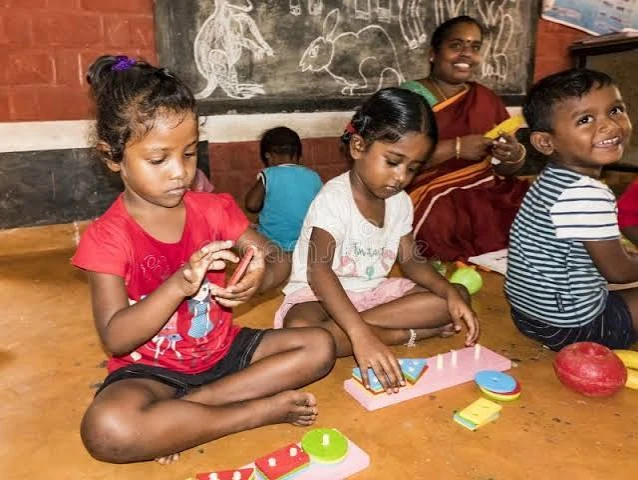
Inside a Kahani session
The questions nobody asks them.
A report card records what a child learned. It records nothing about the day they had. These are the questions Project Kahani puts to children — and the answers decide what we build.
Nothing a child says or makes is published without informed consent from the child and their guardian. Read our safeguarding policy.
Our work
Four areas. One idea.
Education, wellbeing, health and opportunity are not separate problems. In a real life they are never apart. The child who cannot concentrate, the woman who cannot travel to work, and the family with no safe water are frequently the same household.
Education
A child falling behind is telling us something about their environment. We work on the conditions in which learning happens — the classroom, the teacher’s time, the home, the school itself.
ExploreWellbeing
Emotional health is shaped as much by what surrounds a person as by what is inside them. We build settings where support is available, unashamed and ordinary.
ExploreHealth & Dignity
Clean water, a usable toilet, menstrual dignity, nutrition and basic healthcare are not welfare extras. They are the floor beneath every other outcome.
ExploreEmpowerment
Opportunity is not a matter of willpower. We work on access, safety, expectation and support — so that women and girls can move forward on their own terms.
ExploreHow you will know whether any of this worked.
We would rather report honestly than impressively. Four promises, made before a programme starts rather than after it finishes.
We agree the outcome before we begin.
Not attendance. Not satisfaction. What is meant to change, written down while it can still be argued with.
We return.
A change that has disappeared by month nine was an event, not a change. We go back and find out which it was.
We publish what did not work.
Alongside what did. A sector that only reports its successes teaches nobody anything.
We publish our accounts.
Audited statements and programme reports, every year, on the Governance page rather than on request.
Change does not happen in isolation either.
Whether you fund, partner, teach, build or volunteer — the water changes faster when more people are in it.