We work on environments, not just individuals.
Human development is shaped by the systems a person lives inside. Change the systems and you change what becomes possible. This is not a metaphor we invented — it is a well-established framework, and we have chosen to build an organisation around it.
How we think
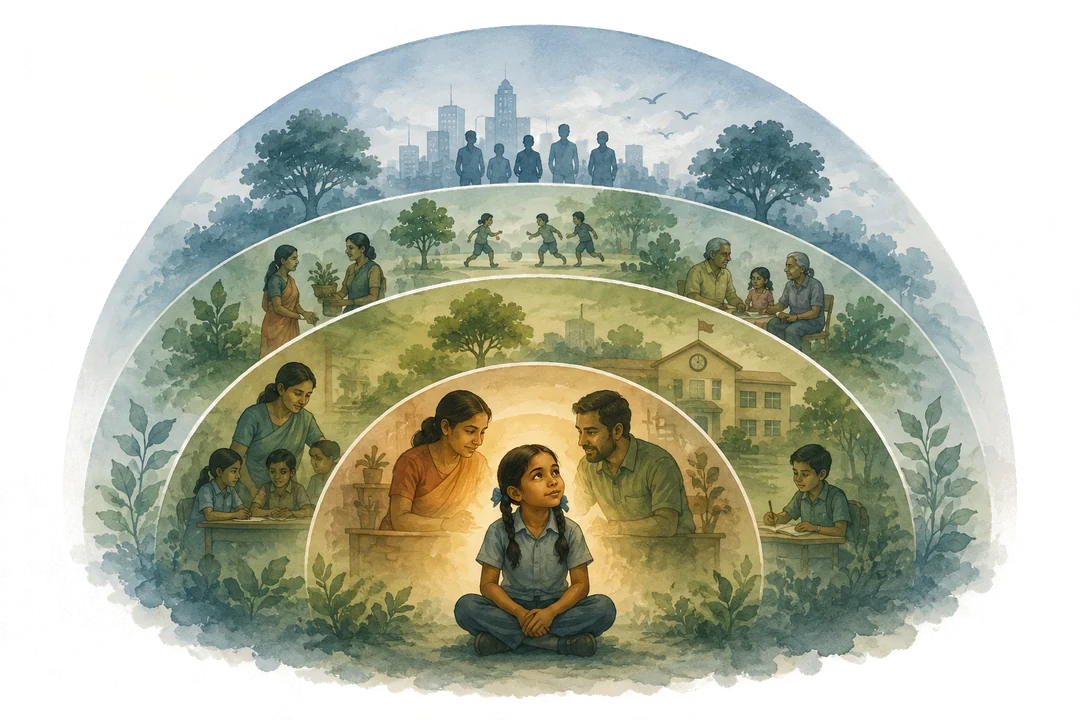
The model
A person grows inside a set of nested environments. The individual sits at the centre. Around them is the family. Around that, the school or the workplace. Around that, the community. And around everything, society — its norms, its expectations, and its unspoken rules about who is allowed to succeed.
Each layer influences the next. A supportive teacher can soften a difficult home. A safe neighbourhood widens what a family will allow its daughter to attempt. A community that treats mental health as ordinary makes it possible for one person to ask for help.
Individual-focused programmes miss this consistently. They support a person for an hour and return them to the conditions that produced the difficulty in the first place.
The method
Listen → Understand → Nurture → Thrive
The four-step spine of every Aadyah programme.
Access is the first question, not the last.
Most programme design begins with content and treats access as a logistics problem to solve afterwards. We reverse that order.
Before we ask what a session should contain, we ask who can physically reach it: at what time, at what cost, over what distance, with whose permission, and with who looking after the children in the meantime. A programme that a person cannot get to is not a programme.
The same applies to the basics. A child cannot concentrate their way out of hunger, thirst, illness or the fear of needing a toilet that does not exist. Where those conditions are missing, addressing them is the education work — not a precondition for it.
What this changes in practice
Boundaries
What we will not do
- We do not run one-day events and call them transformation.
- We do not enter a community without an intention to stay.
- We do not use anyone's difficulty as marketing material.
- We do not photograph children in distress, and we do not publish identifiable details of any child.
- We do not promise outcomes we cannot evidence.
The water is not fixed. It can be changed. That is the entire premise of this organisation.
See what this looks like on the ground.
Four areas of work, one flagship initiative, and a method that touches more than one layer at a time.